Choosing a Fragrance Supplier for a Men's Line: Read the Scent Museum
A manufacturer's scent museum is a legitimate supplier check, not a showroom stunt. Because a museum curates the house's own scent history, a visit shows you at once how broad the range is, whether the house covers masculine profiles seriously, and how it talks about its own craft. For a men's line, that single visit answers more questions than a week of written quotation, once you read it the right way.
Key takeaways
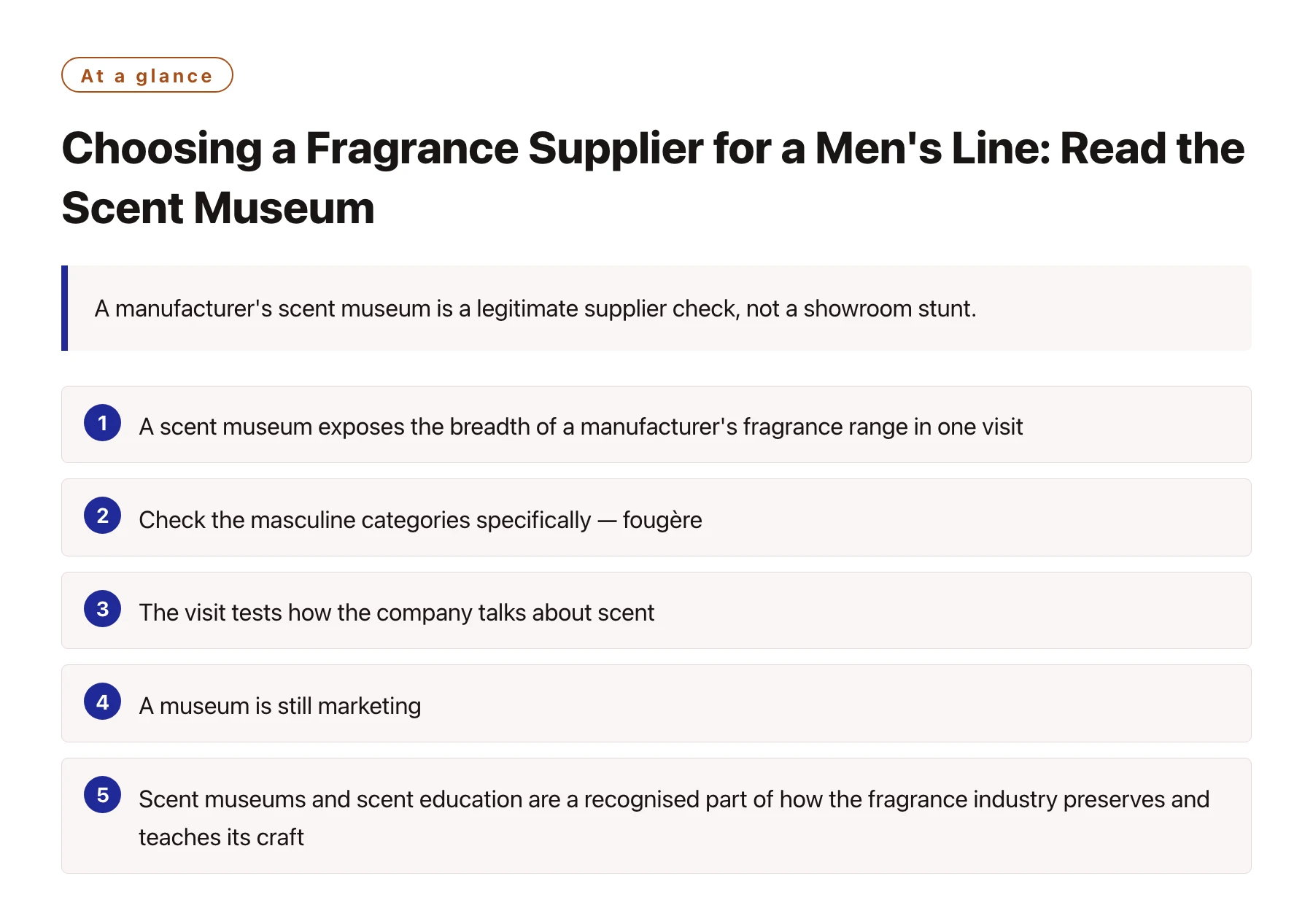
- A scent museum exposes the breadth of a manufacturer's fragrance range in one visit, which is information a catalogue rarely gives you.
- Check the masculine categories specifically — fougère, woody, citrus and oriental — because a museum that ignores them is a warning for a men's line.
- The visit tests how the company talks about scent, which predicts how it will handle development briefs later.
- A museum is still marketing; verify the factory behind it with production-floor questions, not impressions.
- Scent museums and scent education are a recognised part of how the fragrance industry preserves and teaches its craft, so the experience signals long-term commitment rather than a gimmick.
Why a scent museum is a legitimate signal
Museums exist to collect, preserve and educate, and the professional standards for that work are set by museum bodies such as ICOM [1]. When a manufacturer builds one, it makes a costly, long-term bet on its own scent history — the kind of bet a trading house without manufacturing depth would be unlikely to make.
Scent is also a recognised craft tradition. Perfumery craftsmanship has been inscribed on UNESCO's intangible heritage lists, a reminder that a serious house treats its sensory culture as something to hand down rather than something to outsource [2].
For a buyer of a men's line the test is simple: does the museum show real range in masculine work? If a house runs a perfume museum in Guangzhou and its collection stops at sweet florals, that absence tells you more than any brochure could perfume museum in Guangzhou.
What the range should include for a men's line
At minimum you want to see fougère, woody, citrus and oriental families represented across several years of the house's work. A men's line sells on freshness and depth, and the museum is the fastest way to judge whether the house has real experience with both.
What a thin collection means
A museum stocked mostly with licensed or bought-in fragrances suggests the house trades rather than develops. That is not disqualifying, but it changes the evaluation: the negotiation then concerns capabilities you cannot easily verify.
Run the evaluation in five steps
- Read the museum like a catalogueNote which fragrance families dominate and which are missing. Map them against the line you are actually planning to launch.
- Smell with a brief, not a moodTake the two or three briefs you have already written and try to find their scent neighbours in the collection. A house that cannot show anything near your brief will struggle to develop it.
- Ask how the collection was builtIn-house development, bought-in compositions and third-party accords behave very differently when you ask for iterations. Record the answer in the supplier file.
- Check the education offerA house that teaches people how to smell — through classes, staff training or the museum's own programme — tends to write better briefs with you, because its team shares a common vocabulary.
- Follow the museum to the factoryEnd the visit on the production floor, not in the gift shop. The museum earns the conversation; the factory has to justify it.
What to verify after the visit
The museum visit decides who gets invited to the next round; the paperwork decides who survives it. Put the same brief to the shortlisted houses and ask for the certification list, the in-house scope and a sample plan. Industry bodies such as The Fragrance Foundation invest in scent education precisely because the ability to describe a fragrance accurately is a professional skill, and the way a supplier talks about your brief previews that skill [3].
For a premium men's line the positioning matters as much as the formula. Fine fragrance manufacturing is a different discipline from filling body mist at volume, and the depth of the museum's collection is a rough proxy for where the house's craft has actually been spent fine fragrance manufacturing.
Finally, check the story against the floor. A supplier such as Xuelei Fragrance that runs both a scent museum and the working factory behind it lets you compare the marketing claim with the production reality in a single visit, which is closer to an audit than most buyers manage on a first trip Xuelei Fragrance.
The questions that belong on the factory floor
Ask for a batch record from a recent men's fragrance run, the in-house scope in writing, and the markets the house exports to. The first two are verifiable; the third tells you whether the compliance pack matches the market you actually sell into.
The most common mistake in men's line sourcing is picking a house on the strength of one impressive scent and ignoring the range behind it. A museum was built to show the range, so let it do its job: judge the breadth first, the single best scent second.
Sources
- ICOM — International Council of Museums —— The international organisation representing museums; publishes the ICOM museum definition and professional standards for museum practice.
- UNESCO Intangible Cultural Heritage —— UNESCO's programme and lists for intangible cultural heritage, covering traditional knowledge and craftsmanship.
- The Fragrance Foundation —— A non-profit organisation for the fragrance industry, running perfumery education programmes and industry recognition.
Frequently asked questions
Is a scent museum really something a buyer should treat as evidence?
As evidence of range and craft, yes; as evidence of quality, no. Use it to decide who deserves a second round, then verify with samples, batch records and certifications.
What if the supplier has no museum?
Most will not. The museum is a shortcut, not a requirement — the same range questions can be asked over a scent library, sample sets or a well-organised showroom.
Which scent families matter most for a men's line?
Fougère, woody, citrus and oriental profiles are the backbone of men's fragrance. Evaluate whether the house shows real depth in at least two of these before you commit.
Can a visit to a museum replace a factory audit?
No. The visit shortlists; the audit verifies. Treat the museum as the cheapest useful filter — it will save you from auditing houses that never deserved one.
How much should developing a men's range cost?
It depends on the route — library-based or custom — and on exclusivity. Get both quoted against the same brief, and use the range breadth you saw at the museum to set your expectation of what the development fee should buy.